← Past Weeks · View This Week →
WEEK 02 · PURPOSE & AMBITION
What are we building
—and why?
Before we ask how to grow a business, let’s ask what would make it worth building.
01 / SINCE LAST WEEK
What did you try?
Last week was about starting with what you have. How did it go?
- What small step did you take?
- What did you learn—or what got in the way?
Looking ahead
What do you hope your business will give you—freedom, income, meaningful work, or something else?
02 / OPEN THE WORD
If God offered you whatever you asked for, what would you choose?
Solomon asks for wisdom · 1 Kings 3:5–15
The situation
Solomon has succeeded his father David as king of Israel. The responsibility is enormous, and he recognizes his own inexperience. At Gibeon, God appears to him in a dream and invites him to ask for a gift. Solomon’s answer reveals what he believes he needs most to lead the people entrusted to him.
Read 1 Kings 3:5–15
Verses 7–12 highlight Solomon’s need, his request, and God’s response.
5 In Gibeon, the LORD appeared to Solomon in a dream by night; and God said, “Ask for what I should give you.”
6 Solomon said, “You have shown to your servant David my father great loving kindness, because he walked before you in truth, in righteousness, and in uprightness of heart with you. You have kept for him this great loving kindness, that you have given him a son to sit on his throne, as it is today.
7 KEY VERSE Now, LORD my God, you have made your servant king instead of David my father. I am just a little child. I don’t know how to go out or come in.
8 KEY VERSE Your servant is among your people which you have chosen, a great people, that can’t be numbered or counted for multitude.
9 KEY VERSE Give your servant therefore an understanding heart to judge your people, that I may discern between good and evil; for who is able to judge this great people of yours?”
10 KEY VERSE This request pleased the Lord, that Solomon had asked this thing.
11 KEY VERSE God said to him, “Because you have asked this thing, and have not asked for yourself long life, nor have you asked for riches for yourself, nor have you asked for the life of your enemies, but have asked for yourself understanding to discern justice,
12 KEY VERSE behold, I have done according to your word. Behold, I have given you a wise and understanding heart, so that there has been no one like you before you, and after you none will arise like you.
13 I have also given you that which you have not asked, both riches and honor, so that there will not be any among the kings like you for all your days.
14 If you will walk in my ways, to keep my statutes and my commandments, as your father David walked, then I will lengthen your days.”
15 Solomon awoke; and behold, it was a dream. Then he came to Jerusalem and stood before the ark of the LORD’s covenant, and offered up burnt offerings, offered peace offerings, and made a feast for all his servants.
World English Bible (public domain). Read 1 Kings in context.
Main ideas
- Start with humility. Solomon admits that the task is greater than his experience.
- Ask for wisdom to serve. His request is connected to the needs of the people he leads.
- Examine what you want most. God commends his desire to discern justice rather than seeking wealth, long life, or victory over enemies.
God’s gift of riches to Solomon is part of this particular story, not a promise that seeking wisdom will make every business wealthy.
Discuss
- What stands out about what Solomon asks for—and why?
- If God gave you this invitation, what would you honestly ask for?
- Who would benefit if God gave you what you are currently pursuing?
03 / OPEN THE WORD
What are you counting on success to give you—and can it actually deliver?
The rich fool · Luke 12:13–21
The situation
Someone in the crowd asks Jesus to intervene in an inheritance dispute. Jesus responds with a warning about greed and tells a story about a rich man whose land produces an abundant harvest. The man plans for more storage and years of comfort, but his plans leave out the reality that his life can end that very night.
Read Luke 12:13–21
Verses 15 and 19–21 highlight Jesus’ warning, the man’s hopes, and the story’s turning point.
13 One of the multitude said to him, “Teacher, tell my brother to divide the inheritance with me.”
14 But he said to him, “Man, who made me a judge or an arbitrator over you?”
15 KEY VERSE He said to them, “Beware! Keep yourselves from covetousness, for a man’s life doesn’t consist of the abundance of the things which he possesses.”
16 He spoke a parable to them, saying, “The ground of a certain rich man produced abundantly.
17 He reasoned within himself, saying, ‘What will I do, because I don’t have room to store my crops?’
18 He said, ‘This is what I will do. I will pull down my barns, build bigger ones, and there I will store all my grain and my goods.
19 KEY VERSE I will tell my soul, “Soul, you have many goods laid up for many years. Take your ease, eat, drink, and be merry.” ’
20 KEY VERSE “But God said to him, ‘You foolish one, tonight your soul is required of you. The things which you have prepared—whose will they be?’
21 KEY VERSE So is he who lays up treasure for himself, and is not rich toward God.”
World English Bible (public domain). Read Luke 12 in context.
Main ideas
- Possessions cannot define a life. Jesus challenges the belief that having more means living well.
- Wealth cannot secure everything. The man treats stored goods as a guarantee of years he does not control.
- Success needs a larger purpose. Jesus contrasts storing treasure for oneself with being rich toward God.
The warning is about greed and misplaced security. Earning, saving, and planning are not themselves condemned; the question is what we trust and whether our plans make room for God and others.
Discuss
- What makes this man foolish: his harvest, his planning, or what he trusts?
- What are you hoping money or business success will give you?
- What could being “rich toward God” look like in ordinary business decisions?
Bring the stories together: Solomon asks for the ability to serve the people entrusted to him. The rich man imagines what his abundance will do for himself. What do our ambitions reveal about what we trust and whom we hope to serve?
04 / THE BUSINESS IDEA
Is your goal serving your purpose—or replacing it?
Choosing the right goals · Arthur Brooks
Before asking how to reach a goal, ask where it will lead you. What kind of life are you building—and who are you becoming along the way?
Purpose gives goals their direction
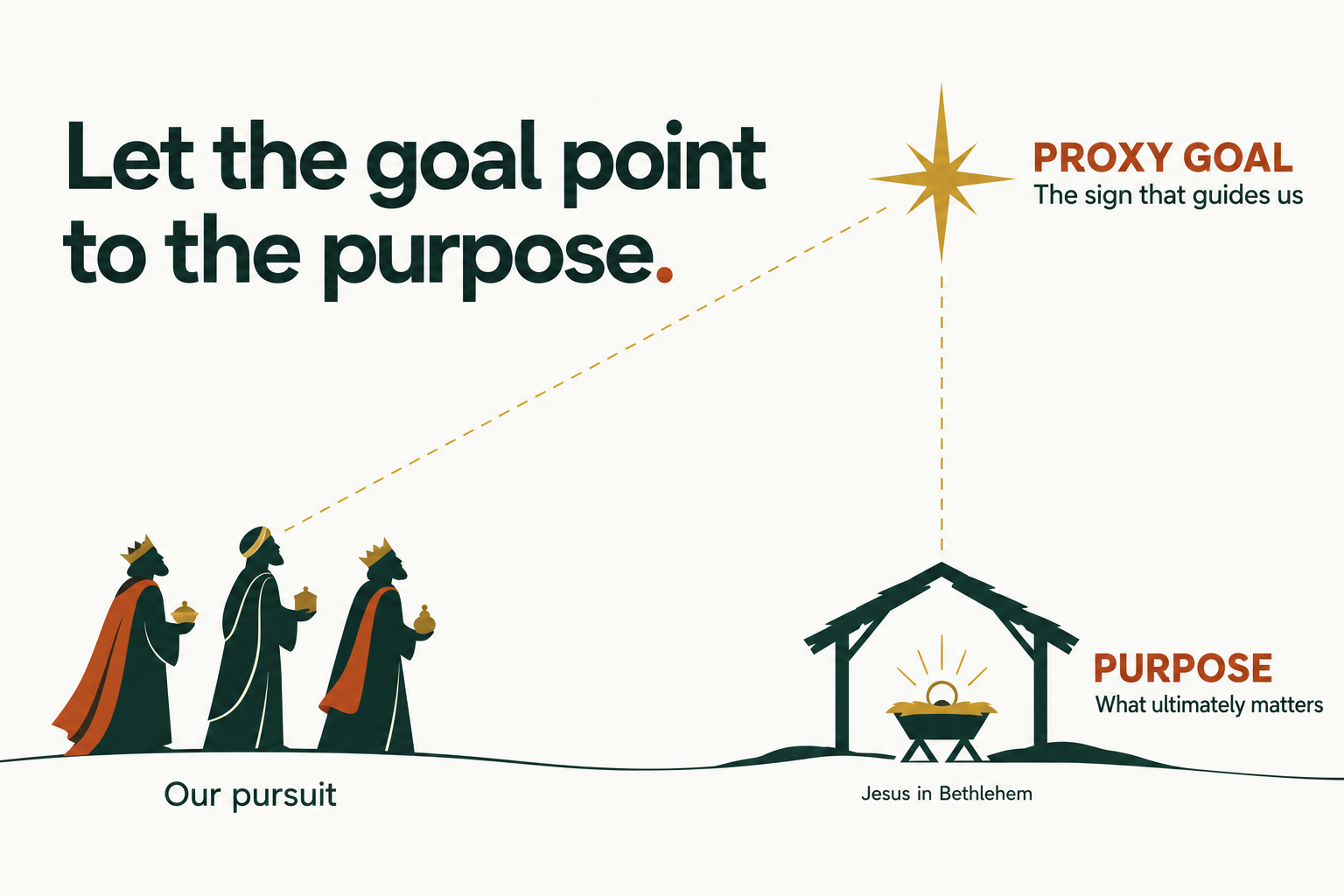
A purpose is the deeper reason for your effort. A proxy goal is a concrete target intended to help you live out that purpose. A target can be measurable and motivating while still pointing you in the wrong direction.
The Star of Bethlehem picture: the wise men followed the star to Jesus; the star was a guide, not their destination. In the same way, a goal should point toward what ultimately matters. Don’t confuse the guide with the purpose it serves.
Three motivations to examine
Extrinsic
External rewards or approval become the main reason for pursuing the goal.
“I want a successful company so people respect me.”
Avoidance
Your goal names what you want to escape without clarifying what you want to move toward.
“I just don’t want to feel like a failure.”
Positional
Success depends on where you stand compared with someone else.
“I need a bigger business than his.”
These examples are applications for our discussion. Earning money and managing risks are necessary parts of business. The question is whether approval, fear, or comparison has become the main force directing your life.
Four directions for better goals
- Focus on love, not things. Ask whom the goal helps you love and serve.
- Listen to the small voice. Make room for quiet reflection. For our group, bring your motives to prayer and Scripture.
- Enjoy the journey. Consider the everyday life your pursuit creates, rather than postponing all fulfillment until you arrive. Meaningful work can still be difficult.
- Stay flexible. Reconsider a target when it no longer serves the purpose behind it.
Bring it into your business
For example, your purpose might be to provide for your family and serve customers well. A profit target can support that purpose. But if pursuing it repeatedly damages family relationships or customer care, the target needs another look.
A weekly check: What did my time and decisions actually serve this week? What should I protect, change, or stop so that my goals stay connected to my purpose?
Discuss
- What is one goal you are pursuing, and what deeper purpose is it supposed to serve?
- Where might approval, fear, or comparison be shaping that goal—and who are you becoming as you pursue it?
- What would change this week if your highest priority received your best attention?
Optional video & chapter links
Arthur Brooks · How to Set the Right Goals in Life ↗
Explore before or after the meeting. Watching is optional.
Based on Arthur Brooks’s episode and official show notes. The business examples, weekly check, and discussion questions are Business Lab applications. The Bethlehem illustration is paraphrased; a secondary episode summary also describes it.
05 / PUT IT INTO PRACTICE
Choose a direction
Write down one goal, the purpose it serves, and the kind of person you want to become as you pursue it.
“My goal is __________. It serves __________. As I pursue it, I want to become more __________. This week, I will prioritize __________.”
Choose one small step this week that reflects that direction. It might be a customer conversation, an honest conversation at home, or a change to where you spend your time. Share your step if you’re comfortable.